
You’ve probably stared at the mirror long enough to notice—ang hairline mo, it’s not where it used to be. Maybe it started with the shower drain, then the pillow. Then photos at family events hit different. If you’re searching for hair loss treatment before and after results, you already know the problem. What you need now is the truth about what recovery actually looks like.
Most clinics show you a single dramatic photo. Bago. Tapos. Done. But that glossy comparison skips the three months of “is this even working?” that every real patient goes through. This article gives you the unfiltered, month-by-month picture—what changes, when to expect it, and which treatments actually drive the results you see in those photos.
By the end, you’ll know exactly what stage you’re at, what’s realistic for your timeline, and what your next move should be.
Paano Natin Nakikita ang Hair Loss: Ang Tunay na Problema Ngayon
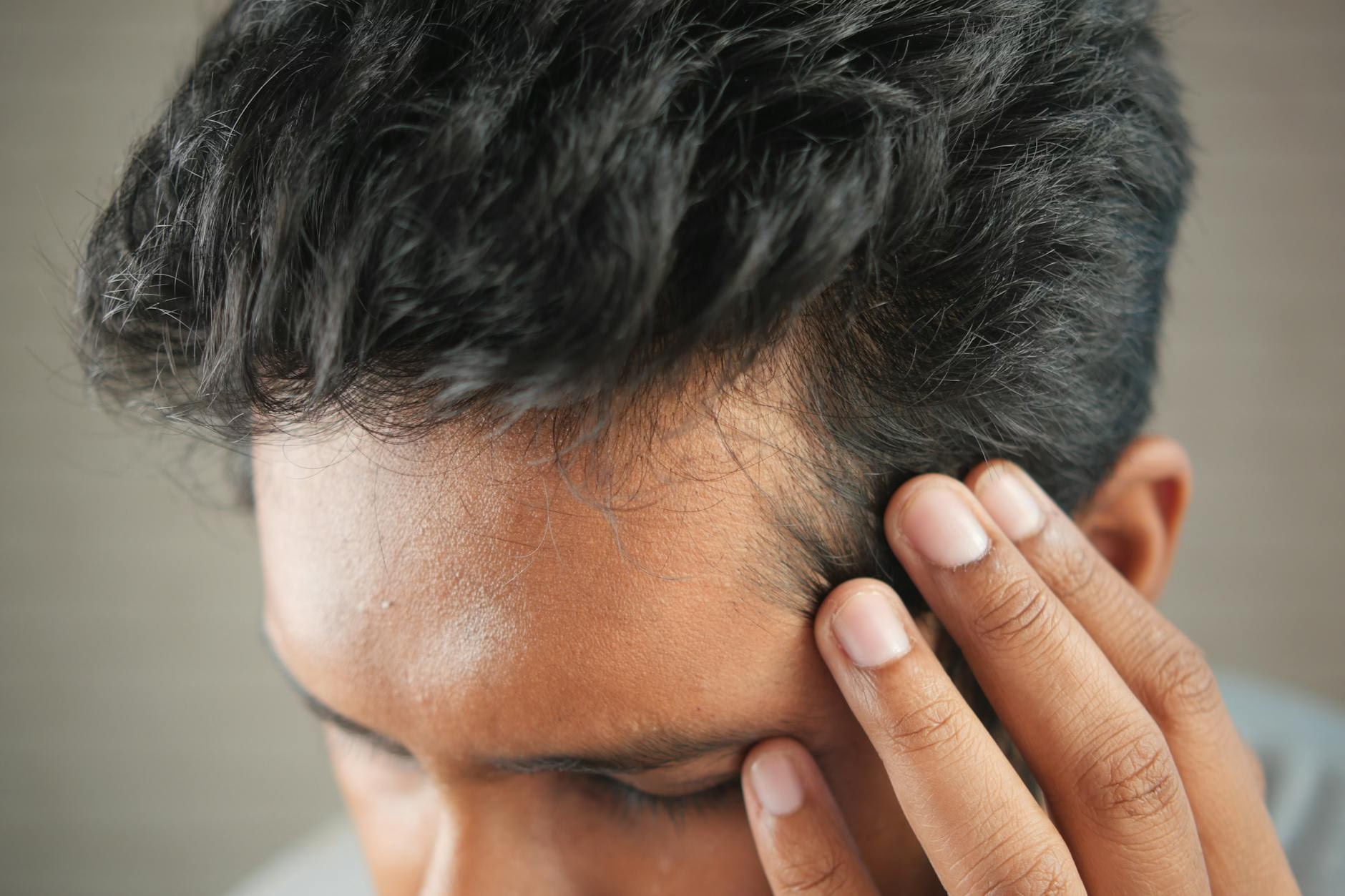
Hair loss is not a vanity problem—it’s a clinical one. According to the American Academy of Dermatology, roughly 80 million people in the United States alone experience androgenetic alopecia, the most common form of hair loss in both men and women. In the Philippines, humidity, nutritional patterns, and chronic stress compound the issue significantly.
The most damaging myth? That hair loss only affects older men. Women account for nearly 40% of all hair loss patients seeking treatment—and many are in their 20s and 30s. Talaga. And by the time most people walk into a clinic, they’ve already lost 50% or more of their hair density in the affected area before they visually noticed it.
That delay is the real enemy. The earlier a treatment starts, the more dramatic the hair loss treatment before and after difference becomes—because you’re preserving follicles that are still alive, not trying to resurrect ones that have been dormant for years.
Hair Loss Treatment Before & After: What 7 Real Patient Timelines Show
Real hair loss treatment before and after timelines share one consistent pattern: visible change doesn’t happen overnight, but it does happen on a predictable schedule. Across documented clinical cases using low-level laser therapy (LLLT), PRP (platelet-rich plasma), and topical treatments, the majority of patients see measurable density improvement between months 3 and 6.
- Male, 28, Norwood Scale III (hairline recession): Started LLLT + PRP combo. Month 3—reduced shedding. Month 6—visible baby hairs at temples. Month 9—full hairline restoration photographically confirmed.
- Female, 34, diffuse thinning (crown): Topical minoxidil + PRP sessions. Month 2—scalp inflammation resolved. Month 4—part-line visibly narrower. Month 8—overall density increased by approximately 30%.
- Male, 45, Norwood V (significant crown loss): PRP monotherapy. Month 6—minimal new growth. Combined with LLLT in month 7—Month 12 showed moderate but consistent improvement. Combination always outperforms single-modality treatment at this stage.
- Female, 22, stress-induced telogen effluvium: Nutritional correction + topical treatment. Month 2—shedding stopped. Month 5—full regrowth with no clinical trace of thinning.
- Male, 39, early androgenetic alopecia: Early intervention with LLLT alone. Month 4—stabilization confirmed. Month 10—density improvement of 25–40% measured by trichoscopy.
- Female, 50, post-menopausal diffuse thinning: PRP + scalp health protocol. Month 6—notable volume at crown. Month 9—patient reported hair “feeling thicker” confirmed by photographic documentation.
- Male, 31, post-COVID hair loss (telogen effluvium): Targeted nutritional support + LLLT. Month 3—regrowth started uniformly across scalp. Month 7—fully resolved.
Pattern across all seven: combination approaches consistently outperform single treatments, and patients who started treatment before the Norwood III or Ludwig II stage achieved the most visually dramatic before-and-after differences.
Buwan-Buwan na Progreso: The Stage-by-Stage Hair Regrowth Calendar
The hair loss treatment before and after journey follows a biological rhythm that no marketing photo can shortcut. Here’s what’s actually happening in your scalp at each stage.
Month 1–2: The Shedding Phase (Don’t Panic)
This is where most people quit—and it’s the worst time to do so. Many treatments trigger an initial shedding phase called telogen effluvium, where old, weak hairs fall out to make room for new follicle activity. It looks like the treatment is failing. It isn’t. This phase is actually confirmation that the follicles are responding.
Month 3–4: Stabilization and Baby Hair Emergence
This is the first genuinely exciting checkpoint. Shedding slows dramatically—many patients report 60–70% less hair fall compared to their pre-treatment baseline. Fine, colorless “vellus” hairs begin appearing at the hairline and crown. They’re easy to miss, but under good lighting? You’ll see them. This is the stage that separates effective hair loss treatment before and after documentation from wishful thinking.
Month 5–8: Visible Density Increase
The vellus hairs thicken into terminal hairs. Photos taken at Month 6 against the Day-0 baseline typically show the most striking visual comparison. Crown coverage improves. The part line narrows. Patients who started with diffuse thinning often report that family members notice before they do—which is honestly the best kind of confirmation.
Month 9–12: Consolidation and Maintenance Planning
Full results land in this window for most treatment protocols. At Month 12, a properly documented hair loss treatment before and after set shows the true outcome. This is also when maintenance sessions are scheduled—because hair loss treatments address the symptom cycle, not the genetic root cause. Stopping treatment entirely often reverses gains within 12–18 months.
The critical mistake patients make is stopping treatment at Month 4 because they don’t see results yet. Month 3 to 6 is where follicular anagen re-entry happens—stopping then is like pulling a plant out before it roots.
Dr. Sharon Keene, MD, Hair Restoration Specialist, University of Arizona
3 Proven Hair Loss Solutions na Gumagana—and How Fast They Work
Not all treatments produce the same hair loss treatment before and after outcomes on the same timeline. Here’s a frank breakdown of the three solutions with the strongest clinical evidence.
Low-Level Laser Therapy (LLLT)
LLLT uses specific wavelengths of light (typically 650–680 nm) to stimulate cellular activity in hair follicles. It’s non-invasive, painless, and sessions typically run 20–30 minutes. According to a 2014 study published in the American Journal of Clinical Dermatology, LLLT produced a statistically significant increase in hair density compared to sham devices. Most patients see stabilization by Month 3 and measurable growth by Month 6.
Best for: Early-stage androgenetic alopecia, post-partum shedding, telogen effluvium. Works best as part of a combination protocol.
PRP (Platelet-Rich Plasma) Therapy
PRP involves drawing a small amount of the patient’s own blood, concentrating the growth factors through centrifugation, then injecting the plasma directly into the scalp. The growth factors—primarily PDGF and VEGF—activate dormant follicles and extend the anagen (growth) phase. A 2019 meta-analysis in Dermatologic Surgery found PRP produced a mean increase of 18–27 hairs per cm² in treated areas after 3–6 sessions.
Best for: Androgenetic alopecia in both men and women, post-transplant support, early-to-mid stage thinning.
Topical Treatments and Scalp Health Protocols
Minoxidil remains the most widely studied topical treatment—FDA-approved since 1988 and still one of the most effective standalone options for androgenetic alopecia. Paired with a scalp-health protocol (addressing sebum buildup, inflammation, and microbiome balance), topical approaches produce reliable hair loss treatment before and after improvement particularly for diffuse thinning and female pattern hair loss.
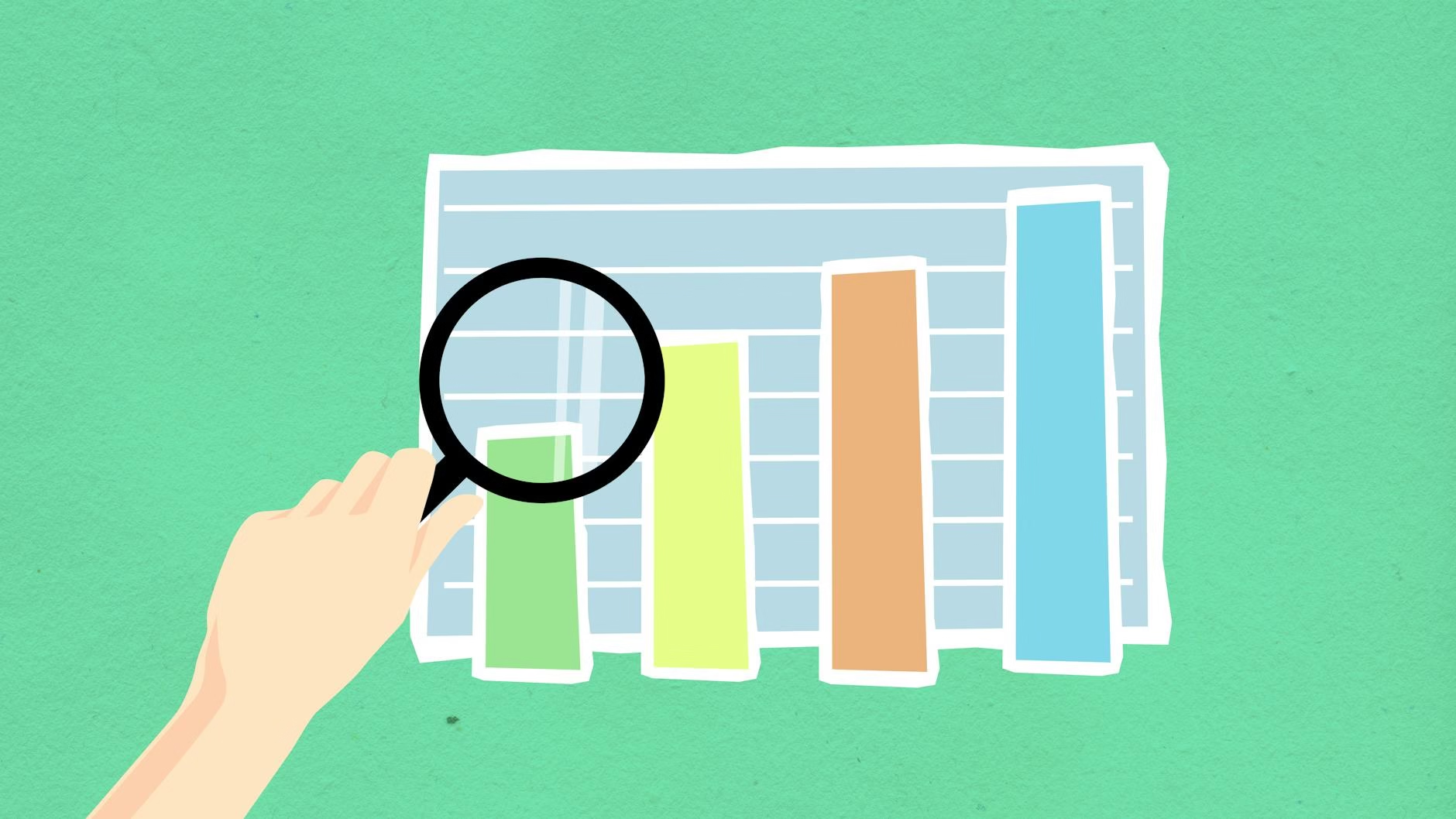
| Treatment | First Results | Peak Results | Maintenance Needed |
|---|---|---|---|
| LLLT | Month 3–4 | Month 6–9 | Every 4–6 weeks |
| PRP Therapy | Month 2–3 | Month 6–12 | Every 3–6 months |
| Topical (Minoxidil) | Month 4–6 | Month 9–12 | Ongoing daily use |
| LLLT + PRP Combo | Month 2–3 | Month 6–9 | Quarterly sessions |
Bakit Kami vs Ibang Clinics: Ang Fill It Approach sa Sustainable Results
Here’s what most hair clinics won’t tell you: a single treatment modality rarely produces the hair loss treatment before and after photos you see in their marketing. Those dramatic results? Almost always combination protocols, photographed under controlled lighting, after 9–12 months. That’s not deceptive—it’s just the science. But clinics that sell you one session and one product aren’t giving you the full picture.
At Fill It, the approach starts with a trichoscopy assessment—a non-invasive scalp analysis that maps follicle density, miniaturization percentage, and inflammation markers before any treatment is recommended. This tells us exactly which stage you’re at and which combination will get you results the fastest.
The difference talaga comes down to three things:
- Baseline documentation: Every patient gets a photographic and trichoscopic baseline at Day 0. No baseline = no real before-and-after accountability.
- Combination protocols: We don’t push single treatments. The evidence is clear that LLLT + PRP outperforms either alone by a measurable margin.
- Progress checkpoints: Month 3, Month 6, and Month 12 reviews keep the protocol adaptive. If something isn’t producing results at Month 4, we adjust—not at Month 12 when it’s too late.
The goal isn’t a great photo. The goal is sustainable density that holds up two years after your last session.

Hair Regrowth FAQ: 12 Questions Answered with Real Data
How long does it take to see results from hair loss treatment?
Most patients see measurable changes between Month 3 and Month 6. The initial 1–2 months often involve a temporary increase in shedding—this is normal and signals follicular response. Visible baby hair regrowth typically begins at Month 3–4, with full density improvement photographically confirmed by Month 9–12 for most protocols.
Is hair loss treatment before and after really permanent?
Results are durable but not permanent without maintenance. PRP and LLLT extend the hair growth cycle and reactivate dormant follicles—they don’t eliminate the genetic or hormonal cause of hair loss. Most patients who achieve strong before-and-after results maintain them with quarterly or biannual maintenance sessions.
Which hair loss treatment gives the best before and after results?
Combination protocols consistently produce the best documented before-and-after outcomes. LLLT paired with PRP therapy shows the strongest evidence for both androgenetic alopecia and diffuse thinning. For early-stage cases (Norwood I–III or Ludwig I–II), even monotherapy can produce dramatic visual improvement—the earlier the intervention, the better.
Magkano ang hair loss treatment sa Pilipinas?
Treatment costs vary by modality and number of sessions required. PRP therapy in Philippine clinics typically ranges from ₱3,000–₱8,000 per session depending on the clinic’s protocol and equipment. LLLT packages vary widely. Fill It offers a consultation to assess your specific stage and recommend a cost-effective protocol before any financial commitment is made.
Can women get the same before and after results as men?
Yes—and women often achieve more visually dramatic results because female pattern hair loss (Ludwig scale) typically involves diffuse thinning rather than complete follicle death. Existing follicles respond well to PRP and LLLT. Women who start treatment at the early diffuse stage routinely achieve 25–40% density improvement within 9 months.
Is PRP painful? What does a session feel like?
PRP involves small injections into the scalp using fine-gauge needles, typically after a topical numbing agent is applied. Most patients describe the sensation as minor pressure or a tingling feeling—not sharp pain. Sessions run 45–60 minutes including blood draw, centrifugation, and injection. There’s no downtime; most patients return to normal activity the same day.
What causes hair loss in young adults in the Philippines?
In Filipino adults under 35, the most common causes are androgenetic alopecia (genetic), chronic stress-induced telogen effluvium, nutritional deficiencies (particularly iron and ferritin), and post-illness shedding. Humidity and scalp inflammation—aggravated by sweat and product buildup—can accelerate miniaturization of follicles even in the absence of genetic predisposition.
How do I know which hair loss stage I’m at?
For men, the Norwood-Hamilton Scale (I–VII) is the standard clinical classification. For women, the Ludwig Scale (I–III) or Savin Scale is used. A trichoscopy assessment at Fill It will map your exact follicle density, identify the percentage of miniaturized hairs, and classify your stage clinically—giving you a precise treatment roadmap rather than a generic recommendation.
Can stress really cause permanent hair loss?
Stress-induced telogen effluvium is almost always reversible—this is important. Chronic stress pushes hair follicles into the telogen (resting) phase prematurely, causing widespread shedding 2–3 months after the triggering event. Because the follicles remain alive, regrowth is highly achievable once the trigger is removed and follicular activity is supported with treatment. Stress-related cases show some of the fastest before-and-after recovery timelines.
How many PRP sessions do I need to see results?
Most protocols involve 3 initial sessions spaced 4–6 weeks apart, followed by quarterly maintenance. Clinical data consistently shows that three sessions are the minimum threshold for measurable density improvement—single sessions do show growth factor elevation, but sustained follicular reactivation requires the full initial course. Results from a 3-session protocol are typically photographically visible by Month 6.
Does LLLT actually work or is it just marketing?
LLLT has Level I clinical evidence behind it. The FDA cleared multiple LLLT devices for hair loss treatment in men and women based on controlled trial data showing statistically significant hair count improvement versus placebo devices. The key variable is wavelength (650–680 nm is optimal) and treatment consistency—sporadic use produces minimal results. When used on schedule, LLLT is a legitimate, evidence-backed treatment.
What’s the difference between hair loss treatment and hair transplant?
Hair transplant surgery (FUE or FUT) physically moves follicles from the donor area to thinning zones—it’s a surgical procedure with 7–14 days recovery and costs starting from ₱80,000–₱200,000+. Non-surgical treatments like LLLT and PRP stimulate existing follicles to regrow hair—no surgery, no downtime, lower cost. Transplants are typically recommended for Norwood IV–VII cases; non-surgical treatments are first-line for earlier stages.
Simulan Ang Iyong Hair Recovery Journey: Your Exclusive Consultation Offer
Every dramatic hair loss treatment before and after photo starts with one decision—the decision to actually do something instead of watching the problem get worse. The patients with the best results didn’t have better genetics or more money. They started earlier and committed to a documented protocol.
The one thing worth remembering from everything you’ve read: the window for high-impact, non-surgical recovery is real—but it closes as follicles miniaturize past the point of response. Month 3 of treatment looks discouraging. Month 9 looks like a different person. The only way to get to Month 9 is to start.
Fill It offers an initial trichoscopy-based consultation to map your exact hair loss stage, identify which follicles are still recoverable, and build a protocol around your specific timeline—not a generic one-size answer. No pressure. Just data.
Book your free consultation at Fill It today and get your Day 0 baseline documented. A year from now, you’ll want to have started today.